
Walk onto a busy airport apron during a peak window, and you will see equipment everywhere. Tugs moving between gates. Dollies being towed across stands. Belt loaders sitting idle while a handler three gates over is looking for one. The same types of equipment, spread across the same apron, not always in the right place at the right time.
This is what ground support equipment management looks like under the traditional model. Each ground handler runs its own dedicated fleet, sized to cover peak demand. It works, but it comes with a cost. Overcrowded aprons. Underused equipment. Duplicate fleets doing the same job side by side. And a constant effort to keep the right assets in the right place without being able to see where everything actually is.
GSE pooling is a direct response to this problem. It is one of the most significant shifts happening in airport operations right now. Understanding how it works is relevant for everyone in ground handling, whether you are a handler, an airport operator, a leasing company, or a GSE supplier.
In this post:
Why the Traditional Model Has Limits
In the traditional model, every ground handler at an airport runs its own fleet. Handler A at Terminal 1 and Handler B at Terminal 2 each own or lease enough equipment to cover their peak operations independently. If their peaks happen at the same time, both need enough equipment to handle them at once, even if assets sit idle for hours in between.
The result is predictable. Aprons fill up with equipment that is not always in use. Capital gets tied up in assets that duplicate what the handler three gates over already has. Maintenance costs multiply. And when something is needed urgently and cannot be found, someone has to go looking for it on foot.
For smaller airports with one or two handlers, this model is manageable. For large international airports with multiple handlers, overlapping schedules, and hundreds of assets moving across the same airside area, it becomes harder to run efficiently.
The pressure to find a better model has been building for years. Rising capital costs, tighter margins in ground handling contracts, growing pressure to reduce apron congestion, and the push toward electric GSE fleets have all pushed the conversation forward. Pooling is where that conversation has landed.
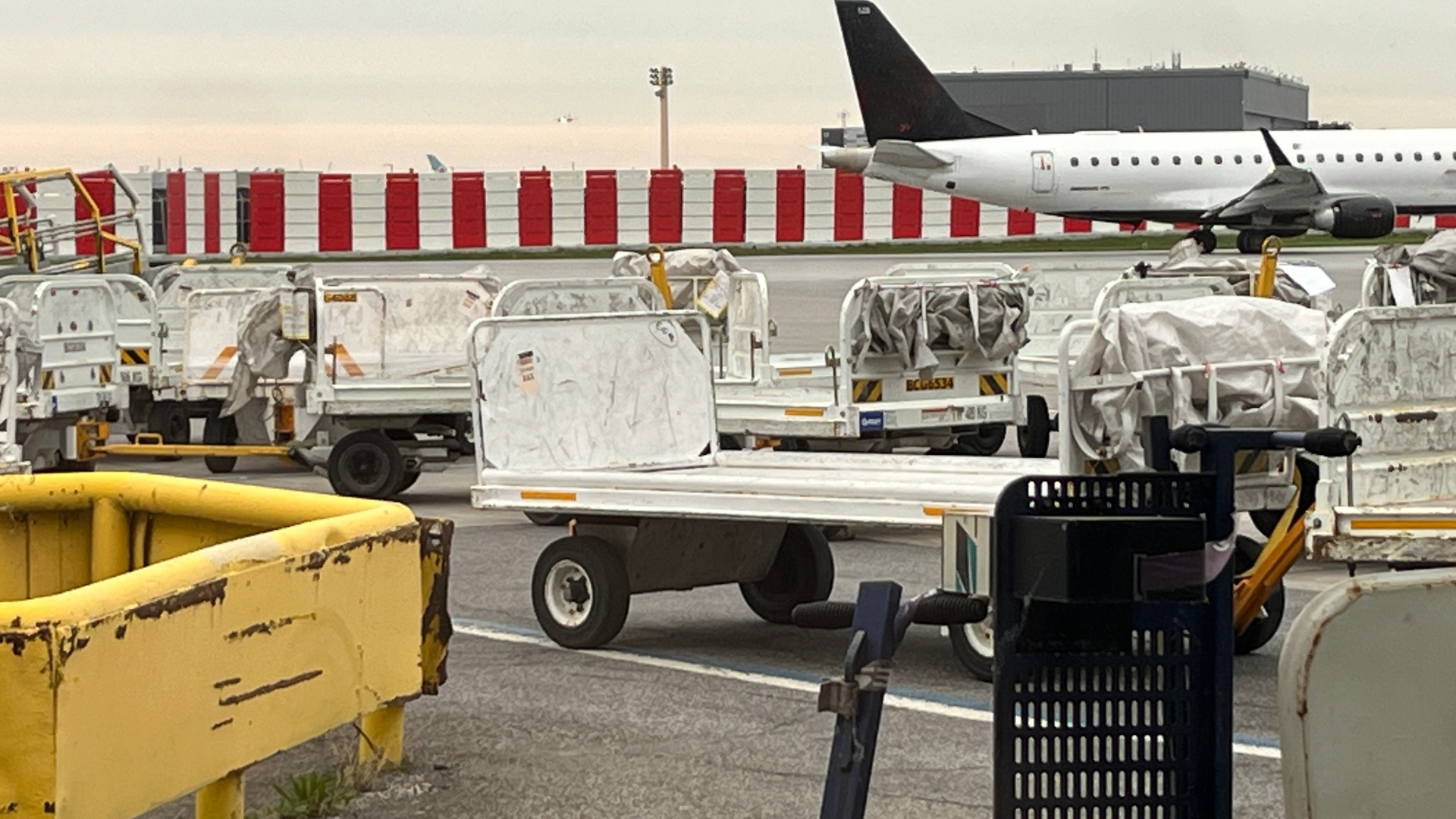
Image: Idle GSE equipment parked on airport apron between flights
What GSE Pooling Actually Means
At its core, GSE pooling means equipment is shared across multiple handlers rather than dedicated to one. Instead of Handler A and Handler B each running separate fleets, a shared pool of equipment is made available to whoever needs it, when they need it.
The benefits follow from this shift. Fewer total units are needed to cover the same demand. The pool absorbs peaks across multiple handlers, so each one no longer has to size their fleet for their individual worst case. Apron congestion decreases. Equipment gets used more. And the capital cost of a large dedicated fleet shifts away from the individual handler.
Pooling also creates new possibilities. When equipment is shared and centrally tracked, it becomes possible to see how assets are used across the whole airport rather than just within one handler's operation. Underused assets can be moved to where they are needed. Procurement decisions can be based on real demand data rather than conservative estimates.
The principle is simple. The implementation is where it gets more complex, because pooling can be structured in several ways depending on who owns the equipment and who manages the pool.
The Three Models of GSE Pooling
There is no single version of pooling. In practice, it takes three distinct forms. Each one has different implications for ownership, management, and accountability.
Airport-Led Pooling
In this model, the airport authority or an Airline Operating Committee owns the GSE fleet and makes it available to handlers on the airfield. Handlers do not own or lease equipment individually. They access what they need from the central pool and pay based on usage rather than owning their own assets.
This model gives the airport direct control over the fleet and its condition. It also reduces the complexity for individual handlers, who no longer need to manage procurement, maintenance, or end-of-life replacement for their own equipment. London Luton Airport is one of the most well-known examples of this model in practice.
The challenge with airport-led pooling is coordination. When multiple handlers draw from the same pool across different terminals and shift patterns, knowing where every unit is and making sure it is in the right condition for the next user becomes a significant operational task.
Lessor-Led Pooling
In this model, a specialist GSE leasing company owns and manages the shared fleet, supplying equipment to multiple handlers at the same airport. The lessor handles procurement, maintenance, and replacement. Handlers pay for access rather than ownership. The leasing company acts as the central coordinator across the pool.
This is currently the most common model at major European airports. Companies like TCR and HiSERV operate this way. It is also the model behind the deployment we supported at Düsseldorf Airport with HiSERV, where more than 850 units of non-motorized equipment are now pooled across multiple handlers on a single shared platform. You can read more about that deployment in our HiSERV case study.
For the leasing company, knowing where every unit in the fleet is at any given moment is not just useful. It is a commercial necessity. Usage data drives invoicing. Location data drives accountability. And with loss rates for non-motorized GSE running at 10 to 20 percent annually at busy airports, visibility is directly tied to the financial health of the leasing model. Our article on why airlines are losing $400 million annually on missing equipment explains the full financial picture.
Handler-Led Pooling
In this model, multiple ground handlers at the same airport agree to share equipment with each other, coordinated through a shared platform. Each handler may still own or lease their own units, but rather than keeping a dedicated fleet, they make assets available to other handlers when not in use.
This model is less common and more complex to sustain. It requires a high level of trust between what are often competing businesses. But it is a practical option at airports where a dominant lessor is not present and where handlers are willing to work together around shared equipment.
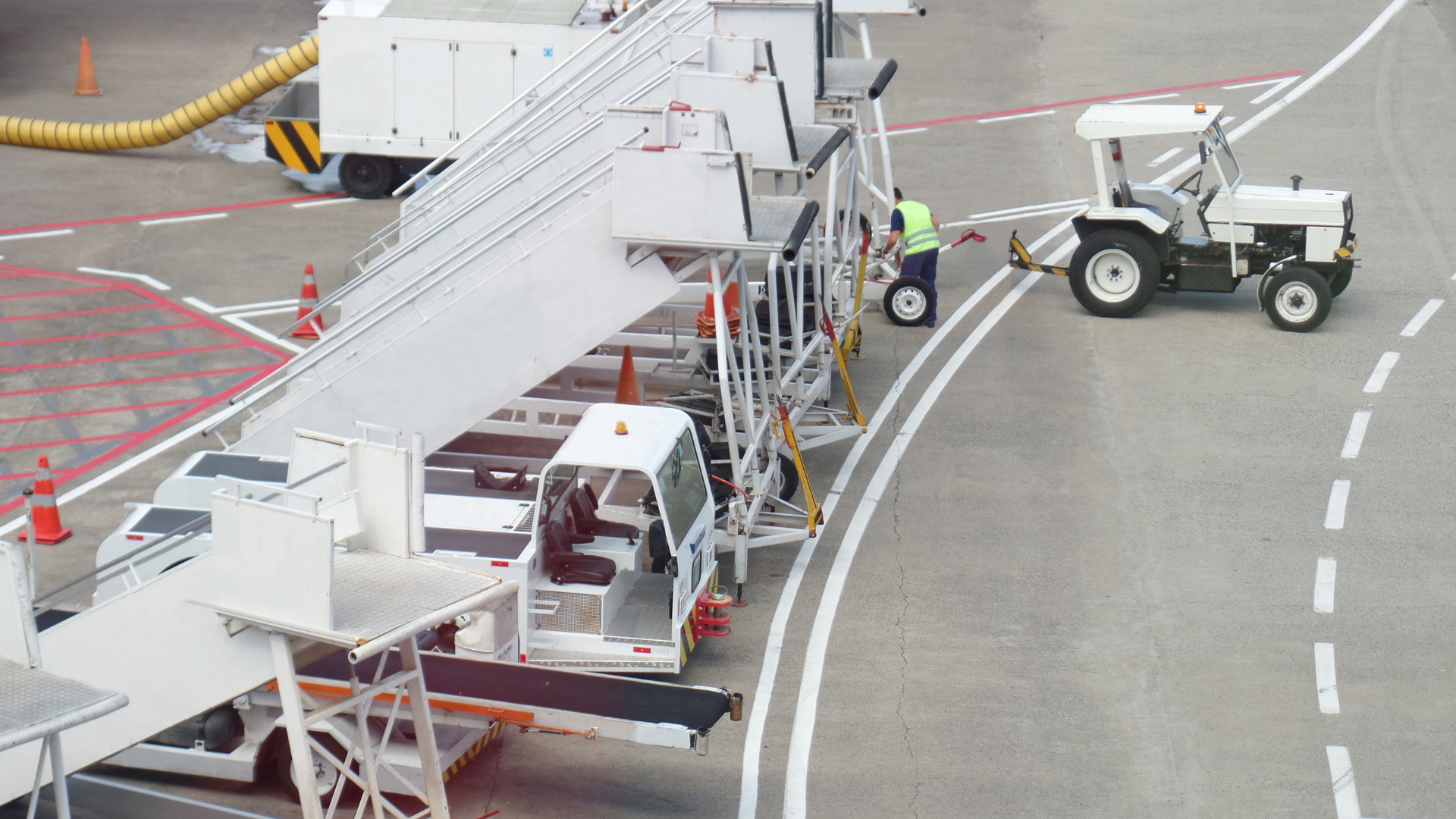
Image: Passenger boarding stairs pooled at the shared GSE zone
Why Visibility Is the Foundation of Pooling
All three models share one requirement:
"You cannot pool equipment you cannot see."
In a dedicated fleet, losing track of an asset is costly but contained. The asset belongs to one operator. The consequences fall on that operator alone. In a pooled environment, the same problem has wider effects. A dolly that drifts to the wrong cluster or the wrong terminal affects every handler in the pool. Invoicing disputes arise when usage cannot be confirmed. Accountability breaks down when nobody can say who last had the equipment. And the efficiency gains that justify pooling in the first place disappear when handlers cannot reliably access what they need.
This is why every serious pooling arrangement needs a technology layer. Location data, status monitoring, and usage history need to be visible to everyone in the pool, not just to whoever last touched the equipment. That shared visibility is what makes coordination possible and what gives the financial model its foundation.
For motorized GSE, this visibility layer has been available through traditional telematics for years. For non-motorized GSE, dollies, towbars, baggage carts, and ground power cables, it has been much harder to achieve. These assets have no engine, no power source, and no built-in reason to fit a tracker. They move constantly between handlers, clusters, and shifts. Once they move, the record of where they are depends entirely on someone updating it manually.
That gap is exactly what battery-powered IoT tracking for non-motorized GSE addresses. And it is why this technology has become a critical enabler for pooling at scale.
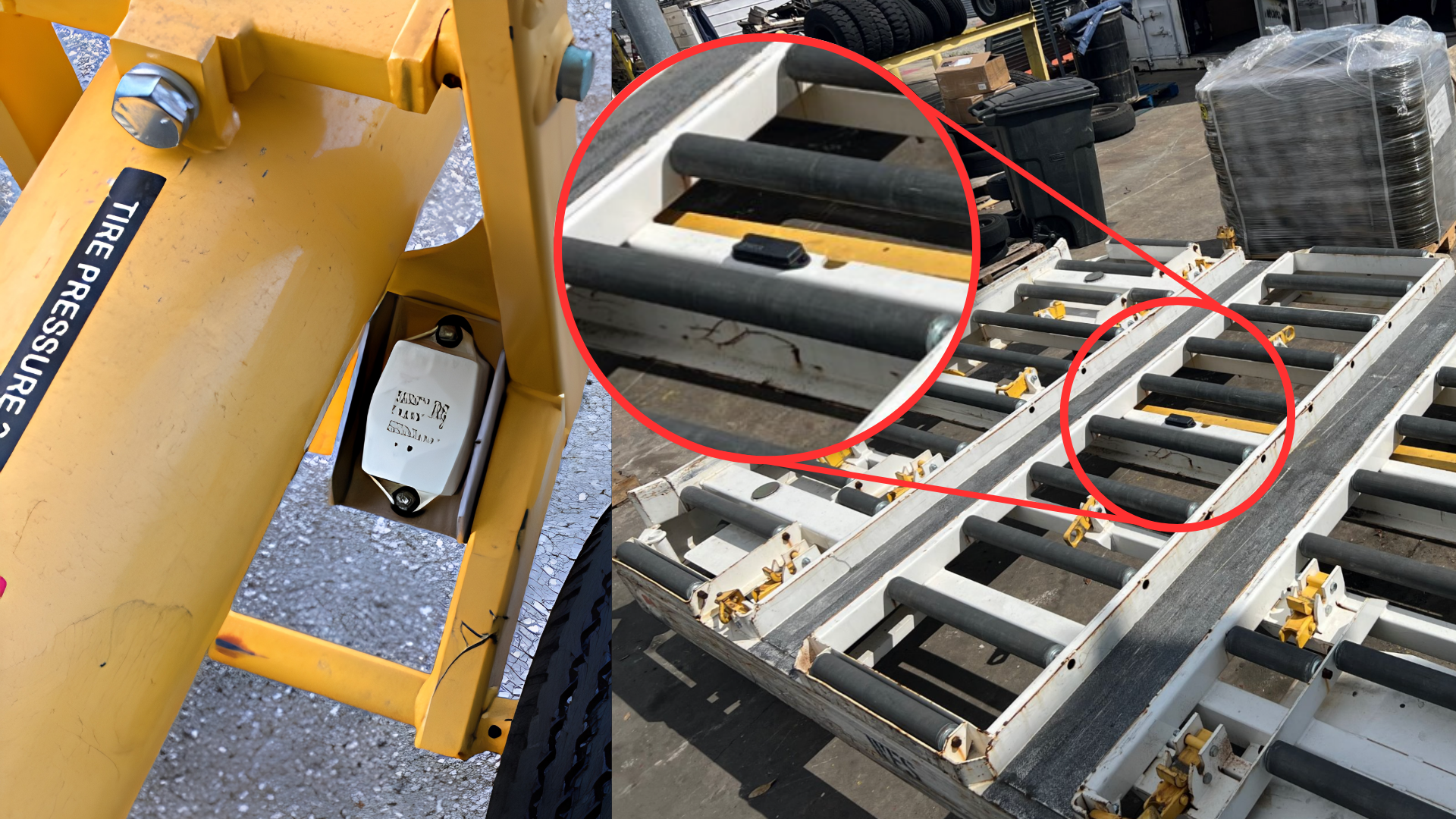
Image: Alps Alpine IoT tracker mounted on GSEs, which are monitored on proveo's platform
What This Means for Non-Motorized GSE
Non-motorized GSE has always been the blind spot in airport equipment management. Because it has no engine and no power source, it has been difficult to track. Manual logs, barcodes, and RFID all have limits in a fast-moving ramp environment. None of them provide the continuous, automatic visibility that pooling requires.
Battery-powered IoT trackers change this. Devices like the Alps Alpine Hati tracker attach directly to a dolly or baggage cart. No modification needed. No power source required. They transmit location data automatically via LPWAN networks like NB-IoT or LTE-M and run for years in the field without servicing. Paired with a condition sensor like the Alps Alpine Skoll, which adds load status and fill level data, pool managers can see not just where each unit is, but whether it is ready to use. You can see all the assets we track on our airport GSE solutions page.
This is what makes non-motorized GSE a full part of a pooled fleet rather than the part of the operation that everyone tracks by memory and manual search.
Where the Market Is Heading
GSE pooling is not a future concept. It is happening now at airports across Europe and beyond. The drivers behind it, rising capital costs, shorter contract cycles, apron congestion, and the push toward electric fleets, are all getting stronger.
For ground handlers, pooling reduces the burden of fleet ownership at a time when margins are tighter and contracts are shorter. For leasing companies, it opens a scalable service model built on usage-based pricing. For airport operators, it offers a path toward a less congested and better-used airside environment. For GSE suppliers, it signals a market that increasingly values equipment that can be tracked, measured, and accounted for.
See you at GSE Expo Europe
We will be exploring each of these perspectives across this series. Articles ahead will look specifically at what pooling means for leasing companies, for ground handlers, and for airport operators. And if you are planning to be at GSE Expo Europe in Lisbon this September, we would be glad to continue the conversation in person. We will be there with our partner proveo, looking forward to talking through what full GSE fleet visibility actually looks like in practice.
Meet us at GSE Expo Europe, Lisbon, 15 to 17 September 2026
Be ahead of the game
Oliver Fortunato, our GSE expert, will guide you through our solution just for you.
Contact us!
Got questions? Book a demo and get the answers you need.
Discover how ALPS ALPINE asset trackers can support your operations, with no pressure or obligation to purchase.
Fill out the form below to connect with our team.
