
Telematics for motorized GSE has been around long enough that most fleets have it figured out. Non-motorized equipment is where the picture gets complicated. Dollies, baggage carts, and towbars have no engine, no power source, and no obvious reason for anyone to fit a tracker. They move constantly across the ramp, change hands between handlers and shifts, and leave almost no trace when they drift out of position.
In a dedicated fleet, that is an operational inconvenience. In a pooled fleet, it is a structural problem. Pooling only works when everyone in the arrangement can see where the equipment is and who last used it. Without that, the financial model falls apart.
This article is the second in our series on GSE pooling and telematics. If you are new to GSE pooling, start with our first article: What Is GSE Pooling and How Does It Work?. Here, we focus on the tracking challenge specific to non-motorized assets in a shared fleet, and what solving it actually looks like.
In this post:
The Real Cost of an Invisible Fleet
At busy airports, non-motorized ramp assets like dollies, pushback equipment, and passenger stairs are among the most frequently misplaced items in the fleet. Staff spend time searching for them instead of handling turnarounds. Operations teams carry larger pools than they actually need just to ensure something is available when required. And when a shortage hits during a peak window, the knock-on effect reaches the flight itself. Our article on why airlines are losing $400 million annually on missing equipment covers the broader financial picture of equipment loss across ground operations.
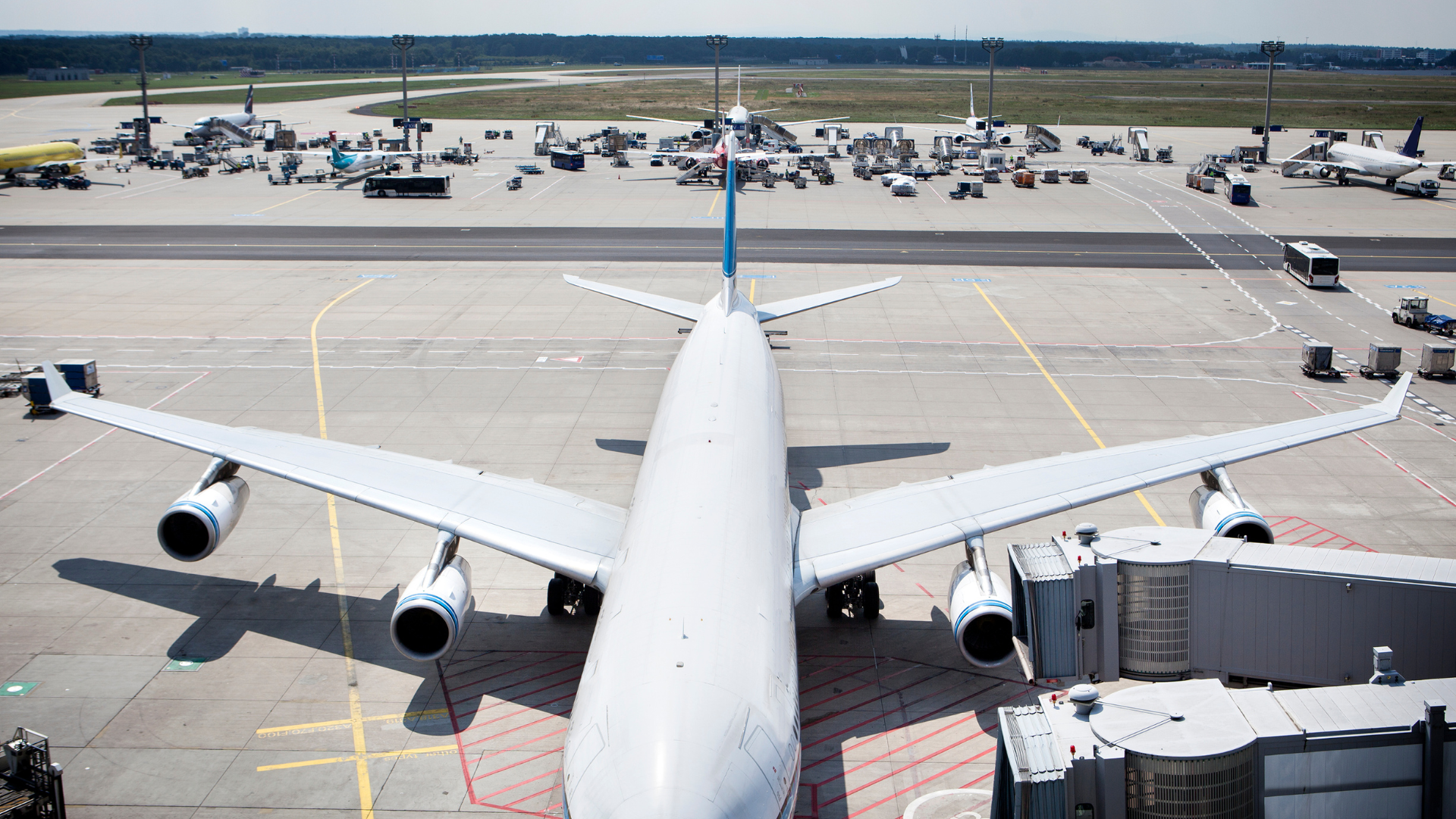
Image: Aerial view of a busy airport ramp with aircraft at gates and ground support equipment in operation
What Breaks Down Without Visibility in a Pooled Arrangement
Pooling requires shared accountability. When equipment moves between multiple handlers and shifts, everyone in the arrangement needs to agree on who had what, when, and for how long. Without location data and usage history, that agreement is very hard to reach.
When a handler is charged for usage they cannot verify, they push back. Without a data trail, both sides are estimating. The dispute costs time and goodwill to resolve, and neither party fully trusts the outcome. When a new shift arrives, and the equipment count does not match what the system says, someone has to go looking. On a busy apron during a peak window, that search comes at exactly the wrong moment. And if this happens often enough, handlers stop returning equipment to the pool at all. They hold onto what they have because they cannot rely on finding it again if they let it go. The sharing logic breaks down quietly, and the efficiency gains that justified pooling in the first place start to disappear.
None of this is unusual. It is what happens when a shared fleet has no shared visibility. And it is why every serious pooling arrangement now depends on a technology layer that did not exist for non-motorized GSE until recently.
If any of this sounds familiar, we are happy to talk through what visibility could look like for your specific pooling setup. Reach out to the Alps Alpine Asset Tracking team, and we will start with your situation, not a product pitch.
What Non-Motorized GSE Tracking Actually Looks Like
The reason non-motorized GSE has been difficult to track is straightforward: no engine, no power source, no obvious place to connect a device. Battery-powered IoT tracking gets around this entirely. While GSE telematics for motorized equipment is well established, non-motorized assets have needed a different approach. The tracker attaches directly to a dolly or baggage cart with no modification and no connection to any power source. It transmits location data automatically via LPWAN networks like NB-IoT or LTE-M. Nobody has to log anything. The data is simply there.
Our Hati trackers are built specifically for this environment. Depending on the use case, they can run for up to 5 years in the field without servicing and are rated IK08 or higher for impact resistance. They work reliably across the range of connectivity conditions you find at a large international airport, including areas where network coverage is inconsistent.
For condition monitoring alongside location, our Skoll sensor pairs with the Hati tracker via Bluetooth. It adds load status and fill level data to the same pipeline. This means a pool manager can see not just where a dolly is, but whether it is loaded or available to use. That distinction matters when someone needs equipment immediately, and the nearest unit turns out to be occupied.
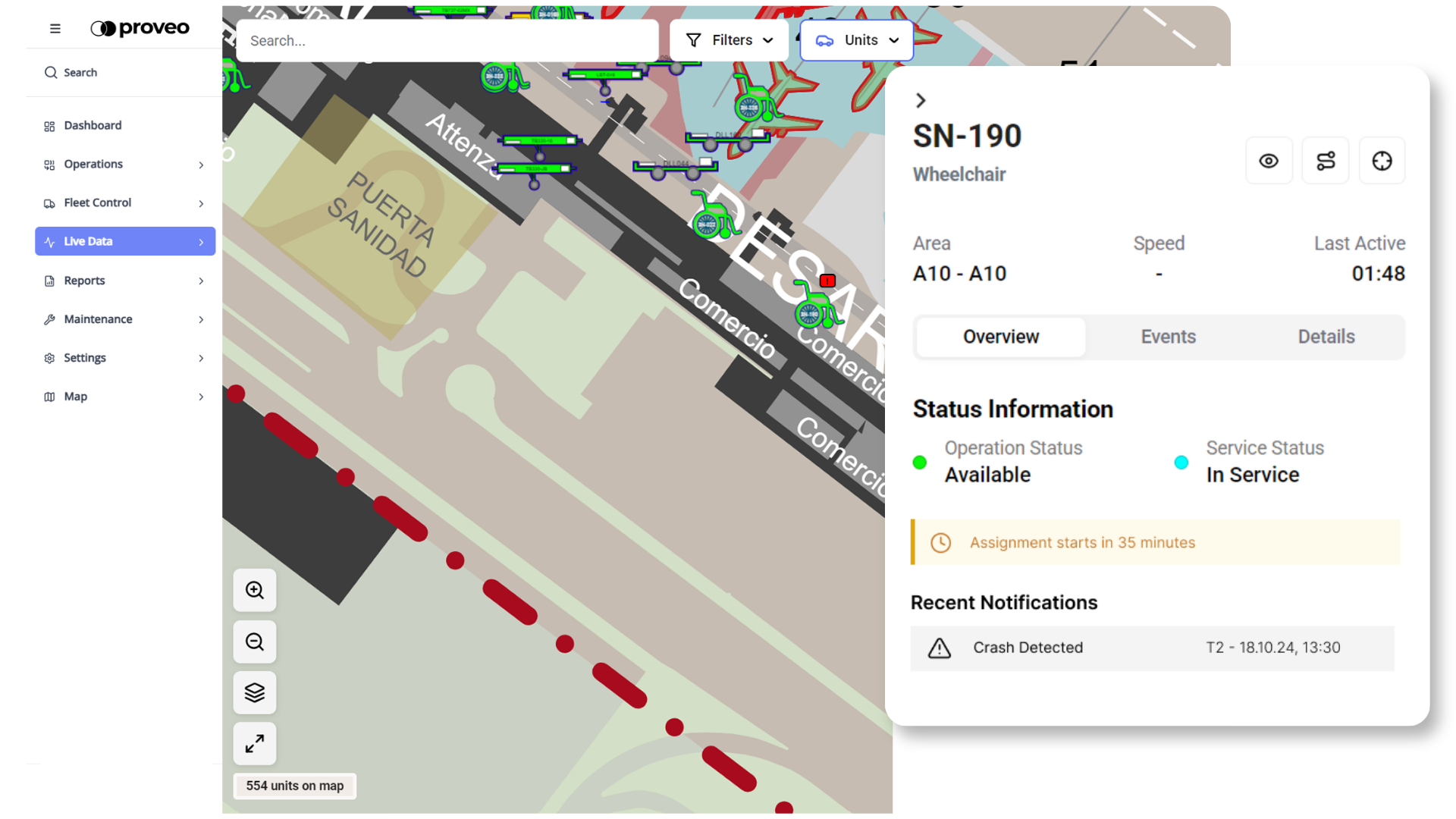
Our partnership with proveo means both motorized and non-motorized GSE sit in the same platform. Alps Alpine hardware feeds location and condition data directly into proveo's system, so motorized assets tracked via telematics and non-motorized assets tracked via battery sensors appear in one view, with the same near-real-time data. No switching between systems. No manual reconciliation.
When it works well, the pool manager stops chasing equipment and starts managing it. Usage is recorded without anyone logging it. Location history exists for every asset. Invoicing is something both sides can actually verify. And when a dolly cannot be found, you check the dashboard rather than calling around and hoping someone knows.
Image: proveo platform showing near-real-time non-motorized airport asset locations and conditions
A Live Deployment: Düsseldorf Airport
In early March 2026, our team was on-site at Düsseldorf Airport with HiSERV GmbH, one of Europe's leading GSE leasing and pooling specialists. Their pooling arrangement at Düsseldorf covers more than 850 units of non-motorized equipment, shared across multiple handlers on the same airfield, with motorised assets planned to follow. Before the deployment, tracking that fleet across handlers and shifts meant exactly the kind of manual processes and incomplete records described above.
We deployed 1,500 devices across the fleet. 750 Hati trackers handle location and transmission. 750 Skoll sensors handle load status and fill level, connected to the Hati devices via Bluetooth. The data feeds directly into HiSERV's own platform, giving their team near-real-time location, asset status, and movement history for every tracked unit.
HiSERV can now see exactly where every tracked unit is, what status it is in, and how it has moved across the fleet. Usage data is no longer based on estimates. Billing disputes are resolvable with a clear data trail.
You can read the full story in our HiSERV case study.
Expanding the Picture With proveo
The HiSERV deployment shows what is possible when non-motorized GSE gets the same tracking attention as motorized equipment. But a deployment where each system sits in a separate platform is only part of the story.
Our partnership with proveo takes this further. Together, we offer a combined solution where both motorized and non-motorized assets appear on the same platform. Location and condition data sit side by side. A pool manager or ground handler gets the full ramp picture at a glance, without switching between systems or reconciling separate data sources.
We have several proof of concepts ongoing with proveo across international airport projects, and we are actively growing the scale of what GSE tracking can cover through this partnership. Düsseldorf is an early example of what the hardware can do. What we are building with proveo is what the full operational picture looks like.
What to Look for When Evaluating a Solution
Not all non-motorized tracking solutions are built for a pooled fleet. Before committing to anything, it is worth pressure-testing a few specifics.
Does it work without a power source?
Non-motorized GSE has no engine and no battery. The tracker needs to be genuinely self-powered with a field life long enough to make the deployment worthwhile.
What are the IK and IP ratings?
Ramp environments are tough. A tracker that does not meet the right protection standards will fail faster than you expect, and replacing units across a large fleet at scale is not a small cost.
Does it integrate with your existing platform?
A separate system for non-motorized GSE that sits alongside your telematics platform creates exactly the reconciliation problem you are trying to solve. The data needs to flow into the same place your team already works.
Can it support usage-based invoicing?
If your pooling model depends on charging handlers for actual usage, the data needs to be granular and reliable enough to support that. A location ping once a day is not enough.
Who has done this before in an airport environment?
Deployment logistics, connectivity configuration, and ongoing support at ramp scale are different from a standard IoT deployment. Make sure the vendor has the experience to back it up.
Meet us at GSE Expo Europe 2026
If you manage a pooled fleet and any of these questions don't have a clear answer yet, that is worth a conversation. Reach out to the Alps Alpine Asset Tracking team and tell us about your setup. We will take it from there.
And if you are heading to GSE Expo Europe in Lisbon this September, come and find us. We will be there with proveo, and we would love to continue the conversation in person.
Contact us!
Got questions? Book a demo and get the answers you need.
Discover how ALPS ALPINE asset trackers can support your operations, with no pressure or obligation to purchase.
Fill out the form below to connect with our team.
