

Introduction
Most airports have spent decades operating with a straightforward assumption: each ground handler owns and manages its own equipment. Every handler that wins a licence brings its own fleet of tugs, dollies, belt loaders, and baggage carts. They store it, maintain it, and replace it. The airport provides the airside infrastructure. The rest is the handler's problem.
That assumption is now being questioned. And in some places, it is already being replaced.
The shift is not happening because airports have decided to take on more responsibility. It is happening because the traditional model creates costs and inefficiencies that are becoming harder to justify. Multiple handlers running separate fleets on the same apron means duplicate equipment sitting idle. Storage areas are overcrowded. The apron is more congested than it needs to be. As aircraft movements grow and safety standards tighten, the pressure to find a better model is building.
This article is the fourth in our series on GSE pooling and telematics. The first three covered what GSE pooling is and how it works, how leasing companies track non-motorized GSE in a pooled arrangement, and how GSE tracking helps ground handlers in a shared fleet. Here we focus on the airport operator perspective: what airport GSE management looks like when the fleet is shared, what GSE telematics makes possible at that scale, and what the technology layer looks like when it is done properly.
In this post:
Why the Traditional Model Is Under Pressure
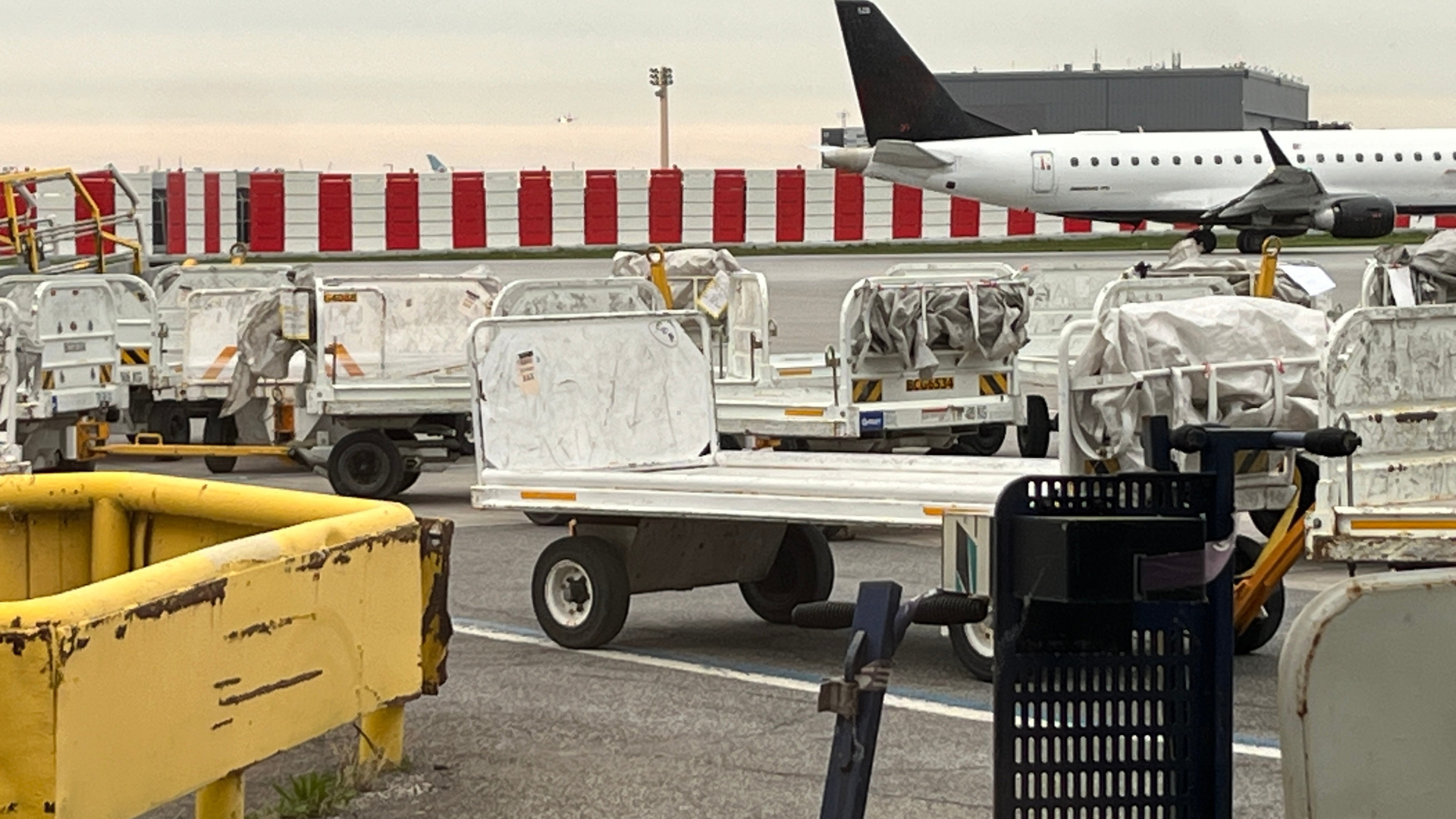
When two or three handlers operate at the same airport, each one sizes their fleet to cover their own peak demand. That means the apron carries far more equipment than it would need if those peaks were managed together. Equipment that is idle for one handler could be available to another, but the separate ownership structure makes that kind of flexibility hard to organise.
Storage and maintenance compound the problem. Each handler needs space to park, service, and repair their own equipment. At busy airports where airside space is already tight, duplicating storage areas and maintenance capacity is a real cost. And as the volume of GSE on the apron grows, so does the pressure on safety. More equipment means more movement and more opportunity for ground damage. <cite index="5-1">IATA reported more than 29,000 aircraft ground damage events in 2025</cite>, and apron congestion is one of the contributing factors.
The licence environment is also changing. Re-tendering exercises at airports across Europe have made long-term fleet ownership a less attractive proposition for handlers. A handler that wins a three-year contract does not want to commit capital to a large GSE fleet that may be stranded when the contract ends. The appetite for shared-service models is growing from the handler side, which creates an opening for airports and dedicated GSE providers to step into a more active role.
Image: Airport storage area with GSE equipment from multiple operators taking up space
What Airport-Led GSE Pooling Actually Involves
Airport-led pooling means the airport authority or a dedicated GSE provider takes responsibility for owning, managing, and maintaining a shared fleet. All handlers at the airport access it. Rather than each handler procuring and running their own equipment, they draw from a common pool and pay based on usage.
In practice, this can be structured in several ways. The airport may own the fleet outright and manage it directly or through a third party. A specialist GSE leasing company may step in as the operator, owning the fleet and contracting with the airport or handlers on a usage basis. What makes airport-led pooling distinct from the lessor-led model we described in Article 2 is governance. In airport-led pooling, the airport operator or an Airline Operating Committee sets the rules and makes sure all handlers operate within the same framework.
The most practical version of this model works like a reservation system. Equipment is organised into defined groups. Handlers can reserve specific asset categories within defined time windows to cover their scheduled flights. A baggage handler knows that three dollies of a specific type will be available at Stand B12 during the 07:00 to 09:00 window. They do not own those dollies. They have guaranteed access to them when they need them, and the system tracks who used what and for how long.
This requires a level of coordination and trust that does not exist automatically. Handlers are often competing businesses sharing the same physical space. Getting them to rely on shared equipment rather than their own fleet requires confidence. Confidence that the system works. That usage is tracked fairly. That costs reflect actual consumption. That confidence comes from the data.
The Data Foundation That Makes It Work
The conversation about airport-level GSE pooling often gets stuck on commercial and operational complexity. Who owns what. Who is responsible for maintenance. How do you handle a handler that keeps equipment longer than agreed. These are real questions, but they all depend on a more basic one.
Can you see what is happening across the entire fleet, in near-real-time, across every handler and every stand?
Without that visibility, pooling at airport scale is not really pooling. It is a set of agreements that nobody can verify. The handler disputes a charge because they cannot confirm the usage. The airport cannot enforce the rules because there is no data trail. The arrangement breaks down as trust erodes.
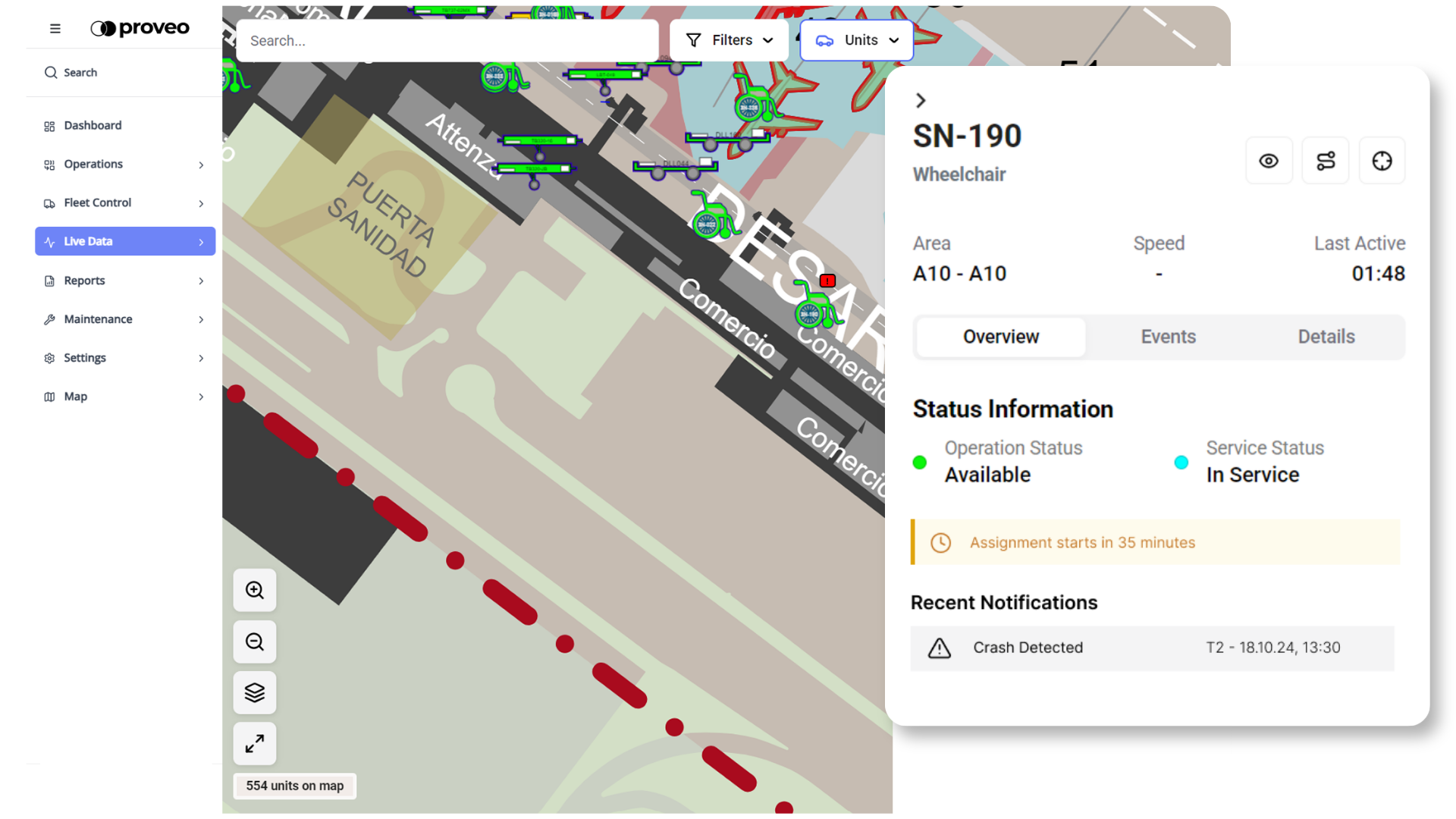
From the smallest piece of ground support equipment to the largest GSE used in aircraft handling, it is now possible to create full operational visibility across the fleet. Battery-powered IoT trackers on non-motorized assets, combined with telematics on motorized equipment, feed a continuous stream of location and condition data into a single platform. Every asset is accounted for. Every movement is logged. Every usage event is timestamped.
This is the data foundation that airport-led GSE pooling needs. Without it, the commercial model cannot function at scale. With it, airports and providers can build pooling arrangements that are transparent, scalable, and genuinely sustainable.
Image: proveo platform displaying shared GSE availability across multiple ground handlers
Cost Allocation in a Shared Fleet
When airport operators and handlers consider a shared fleet model, cost allocation is usually the question that comes up first. If multiple handlers use the same equipment, how do you divide the costs fairly? How do you make sure a handler who uses equipment carefully is not subsidising one that damages it?
Both questions have the same answer: the data foundation that makes visibility possible in the first place.
Costs in a shared GSE fleet can be structured in two layers. Fixed costs, covering equipment availability, standard usage, and depreciation, are calculated automatically based on actual usage data and a predefined algorithm. Each handler's share is proportional to what they actually used, measured by time, movement, and asset category.
Unforeseen costs, such as repairs from damage or misuse, are allocated by responsibility. When a shock sensor detects an impact above a defined threshold, the system logs the event, the asset, the location, and the timestamp. The handler in possession of that asset at the time is identifiable from the movement history. The repair cost follows the responsibility.
Different cost allocation models can be developed and agreed upon with all stakeholders, depending on their requirements and the operational setup at a given airport. The key first step is making sure all relevant data is reliably captured. Once that foundation is in place, the billing models that sit on top of it can be built to fit the specific arrangement. It becomes infrastructure rather than a spreadsheet exercise.
What Full Operational Visibility Looks Like
Alps Alpine Asset Tracking and proveo have built this kind of integrated visibility together. Alps Alpine Hati trackers attach to non-motorized GSE, including dollies, baggage carts, and passenger stairs. No modification to the equipment is needed, and no power source is required. They transmit location data via NB-IoT or LTE-M, running for up to 5 years in the field without servicing and rated IK08 or higher for impact resistance. The Alps Alpine Skoll sensor, paired via Bluetooth, adds load status, fill level, and shock detection. Motorized GSE connects through standard telematics.
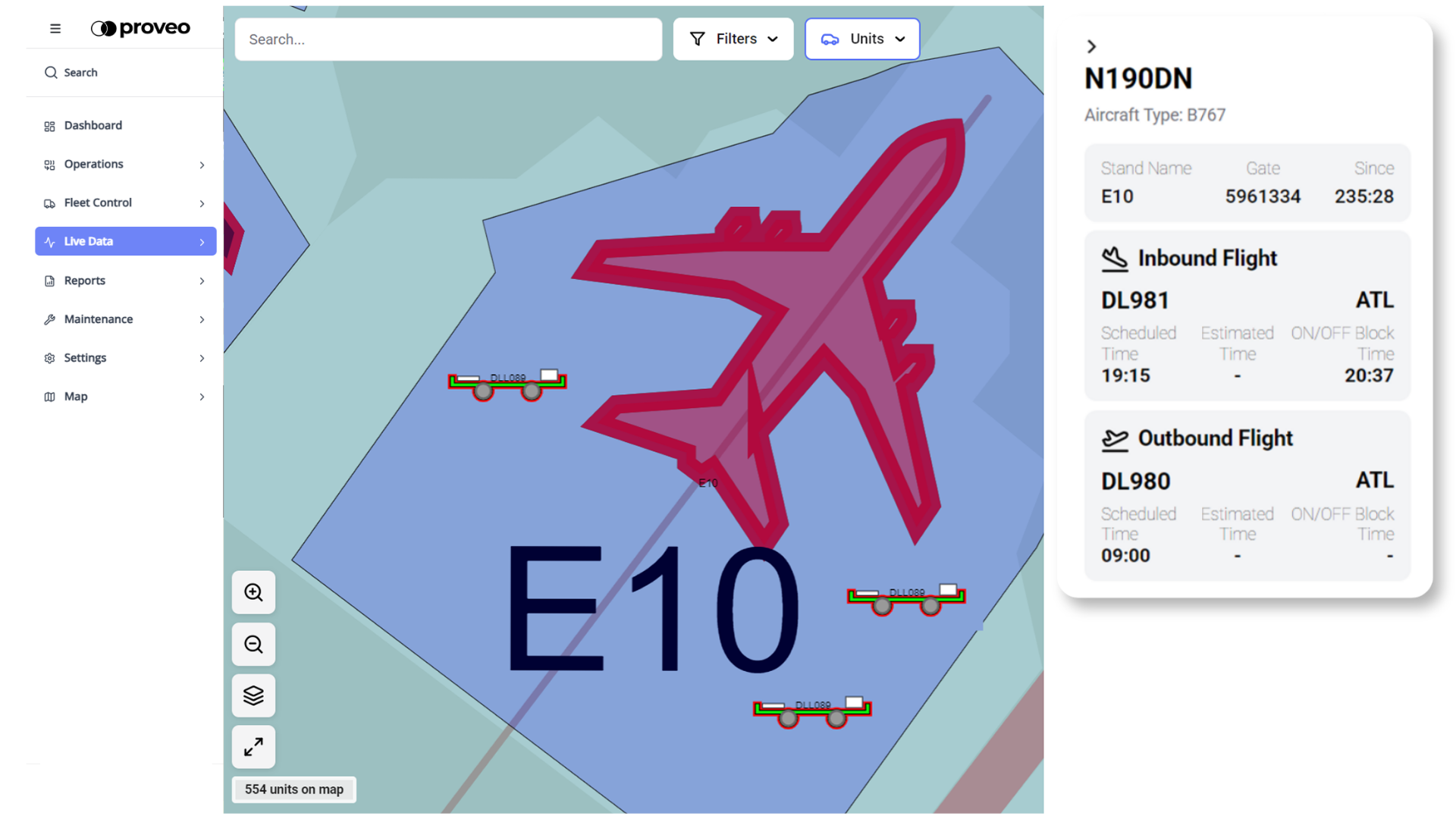
All of this feeds into the proveo platform, giving airport operators, pool managers, and handlers a single view of the complete ramp. Location and condition data for every asset, in near-real-time, in one place. Reservation management, usage tracking, and movement history are all available from the same interface.
Our work with proveo extends across multiple international deployments and proof of concepts currently active in Europe and North America. At Düsseldorf Airport, the HiSERV deployment of 1,500 Alps Alpine devices across a fleet of more than 850 non-motorized GSE units shows what this looks like at scale. You can read the full details in our HiSERV case study.
[IMAGE PLACEHOLDER 4] Alt text ideas:
- proveo and Alps Alpine platform showing full GSE fleet visibility across an airport
- Airport GSE pool manager reviewing near-real-time equipment data across all handlers
- Integrated dashboard showing both motorized and non-motorized GSE status at an airport
Where Airport GSE Management Is Heading
The airports of the future will not need to run countless separate GSE fleets, tying up parking and storage space, duplicating maintenance, and adding unnecessary equipment density to a busy apron. That direction is already clear in the way the most forward-thinking airports and GSE providers are operating today.
GSE is one of the major cost drivers in ground handling. The case for shared-service models is strong enough that most parties should be open to them, given the right data foundation and the right commercial framework. The question is not whether this happens. It is who leads it and when.
EASA's new ground handling regulations, with full compliance required by 2028, will push this shift further. Formal maintenance programs for all GSE, safety management systems, and compliance documentation requirements all point toward a more structured, data-driven approach to fleet management. Airports and handlers that invest in the data foundation now will be better placed to meet those requirements and to build the commercial models that sit on top of them.
The technology exists. The data can be captured. What the transition requires is a willingness to rethink the commercial model rather than defaulting to the way things have always been done. That shift is already underway at the airports that are ahead of it.
Contact us!
Got questions? Book a demo and get the answers you need.
Discover how ALPS ALPINE asset trackers can support your operations, with no pressure or obligation to purchase.
Fill out the form below to connect with our team.
